Saturday, September 30, 2006

Maybe There is Hope After All for Experts

For those of you who don't subscribe to our newsletter, I sent out a request this past week on behalf of an expert who had been designated as an expert in several cases (prompting the settlement of those cases) without permission. I have been astounded (and very appreciative!) by the hundreds of responses I have received.

This situation, what I call DWP (Designation Without Permission) by attorneys, is much more frequent than I had believed and terribly unfair! (I am compiling the responses this weekend and will be posting the compilation here and on our website as a free, downloadable document; I'll let you know as soon as it is available.)

While reading the various experiences of experts in this regard, I was approaching despair, but found a glimmer of hope in a clip from Pacific Business News.
The Hawaii Supreme Court has suspended a 39-year-old California lawyer for a year for placing a newspaper ad intended to discourage an expert witness from testifying in a case.
Darin P. Wright' s suspension took effect Sept. 18, according to the Office of Disciplinary Counsel, which investigates the rules governing lawyers in Hawaii.

While not much, at least someone somewhere is willing to do something about unethical treatment of experts by attorneys!

Thursday, September 14, 2006

Servant or Guru?

Although written with law firms in mind, this blog post by Nathan Burke of Law Firm Blogging was enough to make me pause and look at the big picture in a new light. Agree or disagree with his premise, I love things that inspire me to think!

Wednesday, September 13, 2006

Judges for Hire?

This was new to me, but apparently hiring one's own judge is the latest attempt to get cheaper and quicker "justice".

In the May/June 2006 issue of AARP Magazine I found a blurb about this new practice (unfortunately, I haven't found a link for this particular article). Writer Laura Daily reports that while most popular with celebrities (Brad Pitt and Jennifer Aniston hired a judge to handle their divorce proceedings) the benefits are attracting ordinary folk as well, due in part to the savings in time and money:
Booking your own judge means your lawyer and expert witnesses aren't sitting running the meter while a jurist hears some other case, notes Kathleen Robertson, who practices family law in Los Altos, California. The rental can cost $350 to $475 an hour (a rate you split with your opponent), but because most cases are settled in days instead of weeks, "using a private judge can save 30 to 50 percent in time and fees," she says.

Other benefits include bypassing clogged court systems, the ability to pick a judge who specializes in that type of case, and, unlike arbitration, the decision can still be appealed.

Renting a judge is a practice already in use in California, Colorado and Ohio, with Texas and Florida soon to follow.

Thursday, August 31, 2006

Timothy Snoddy

We want to thank all of our readers who sent their heartfelt condolences on the tragic death of our client and dear friend, Timothy Snoddy in the Comair planecrash in Kentucky this week. Your words and kindness meant a great deal to my mother Rosalie, myself, and to Tim's family.

Untapped Resources for Expert Witnesses

With the information overload we all suffer from, it is easy to settle for the obvious resources for advice, such as material written specifically for your field or industry, or designed especially for expert witnesses.

But if you limit your search in this way, you may be missing out on some great 'insider' information. Articles, newsletters, blogs and books written by and for attorneys can provide a treasure trove of knowledge you can use to improve your skills, performance and success as an expert consultant.

For example, one newsletter I subscribe to is Trial Tips Newsletter by Elliott Wilcox, a Florida trial attorney. In the last few issues he has been sharing tips on creating a clear appellate court record, that he came up with after conversations with a dozen or more court reporters. One of many points experts could find helpful:
"Look up and speak for the record. One of the less obvious tips the court reporters shared was about how your posture affects the record. When read [from your notes] or quote extensively from [records, datasheets, interviews], you probably have a tendency to talk into the piece of paper or down to the paper on your desk. When you look at your papers, rather than looking up ... your voice comes out mumbled, you speak too fast to be understood, you don't pronounce each word individually, and your record comes out garbled. To create a better record, stand up straight, minimize your dependence on your notes, and look at the person you want to persuade."

Don't forget to investigate blogs written by and/or for attorneys, like one by the Association of Trial Lawyers of America. Here's an excerpt from the July 11th post of Tuesday's Litigation Tip
"Do not ask the expert "Why?" or "How can you say that?" (unless you can effectively handle the answer and unless you know in advance that you can effectively handle the answer)."

With books, you'll need to set some criteria or the choices available will overwhelm you. One that I like, written to help lawyers work with expert witnesses, is Expert Rules - 100 (and More) Points You Need to Know About Expert Witnesses by David M. Malone. Here's the kind of advice he offers attorneys about experts:
"When two experts are reasonably equally qualified, choose the expert with whom you feel more comfortable working and spending time. If you and the expert do not enjoy working together, then you will tend to avoid the frequent communication and long hours of preparation that are necessary to succeed. You can think of this as the 'glass of beer' test: if you wouldn't enjoy sitting down and having a glass of beer with the expert, then you probably shouldn't hire her, if you have any choice at all. Expert work is hard enough without overlaying it with personality problems (even if it is your personality that is at fault)."

As long as you take into consideration that the intended reader of these publications is attorneys, I think you might find some to be quite helpful. I'm putting together a 'how-to guide' with tips on finding legal articles, blogs, and newsletters that relate to specific areas of expertise and particular issues. I'll get that done over the holiday weekend and post it here next week.

Monday, August 21, 2006

Expert Witness Breaks the Silence

"I'm out in the wilderness here," is the kind of comment I hear frequently from experts. By it's very nature, being an expert to the legal community can be isolating. You've spent the better part of your life in your field, not the courtroom. Your contemporaries may or may not be practicing expert consultants. And, even if they are, you must watch what you say, do, write, etc., because it can all be misinterpreted or intentionally distorted in an attempt to discredit you.

So, this weekend (when it was too hot to do anything else!) while going through the various stacks in my office, I was excited to run across a particular article again. Printed in Legal Affairs back in March of 2003, "Opinion for Sale: Confessions of an Expert Witness" is a rare glimpse into the raw thoughts of an expert witness, from his initial experiences in the 1970's and the evolution of his practice into the present. Author Steven Moss expresses some ideas that might be offensive and others you may say, "Oh, me too!"

Either way, I think it's a unique take on this very unique field. Beware, it's a long article; you might want to print it out and read when you're standing in line somewhere. Let me know what you think.

Thursday, August 17, 2006

Blogs Are Not for Expert Witnesses

Every once in a while, an expert will approach me about creating a blog, having heard it was a great marketing tool and could increase traffic to their website, etc. And look at all the lawyers and firms that have blogs, right?

Well, No. As many of you know only too well, general marketing principles and guidelines for professional service providers simply don't apply to the expert witness. Fair or not, the rules ARE different for experts. You will quickly work yourself out of contention if you start to promise results or, in marketing speak, "benefits," in your correspondence, marketing materials, or website.

In a similar vein, you do not have the luxury of placing your thoughts and reactions to events or even your commentary online, unless you are VERY, VERY careful and even then I just don't recommend it. Statements can so easily be taken out of context, your opinion and industry methodology can change over time - anything and everything, especially on the Internet, can and will be found and used, either to exclude you from the list of experts to choose from, or by opposing counsel to discredit and possibly disqualify you.

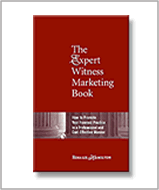
The following, while written as regards writing articles and making presentations, can also be applied to blogs. This is one of my favorite passages from The Expert Witness Marketing Book:

"All of your writing and speaking is discoverable and can be cussed and discussed with you in deposition and in court. Be careful. Be consistent. Investigate, verify, and cross-examine your facts. Proofread, proofread, and proofread again."

And I say it just isn't worth the risk. There are too many other time-tested, proven and effective methods for getting on the radar screens of the attorneys who need your services.

Thursday, August 10, 2006

Attorney "Disciplinary" Agencies

In response to the question in last week's post (see below) about collecting fees due from attorneys, one reader sent me to a page on the ABA site of disciplinary agencies for attorneys, listed by state. But, as another expert illustrates below, contacting these agencies may not be much help.

"...one client even went so far as to sue me to get the retainer back. In discovery I found out she told her opponent I had rendered a favorable opinion for her client so he settled. I had not even rendered an opinion at all, though I was working on the case when she called to say it was settled. Since I record all of my calls, I spoke to opposing counsel and confirmed she lied to him. I turned the tape over to the Ethics Board in NJ and the investigator bent over backwards to defend the lying attorney.

This is why experts get upset. You have a blatant case of unethical and possibly illegal conduct on the part of an attorney and the Ethics Board does nothing and to add insult to injury, is rude and discourteous besides!"

Monday, July 31, 2006

Take a Lawyer to Court?

We've been covering the various business practices experts can use to ensure that they are paid by their retaining attorney clients for their services. But what if it's too late to use prevention methods? What if, in spite of it all, they still refuse to pay?

Experts relate little success in reporting this treatment to the attorney's bar association. And I would be leery of suing an attorney, although at least one attorney came out ahead by taking counsel to Small Claims Court when they refused to pay his bill. The attorney agreed to use the expert for all of his cases where that expertise was needed if the expert agreed to settle for one-third of the award granted by the court. He agreed and the attorney kept his word.

Others have found that third-party collectors are sometimes more successful in collecting monies owed than the expert himself. But this is no guarantee either.

I'm hoping some of you readers can help me respond to the question I received below by sharing what has or has not worked in your practice.

"At the present time I am dealing with an attorney/client of rather dubious ethics. His office had contacted me and after I learned of the particulars of the case, I chose to take the case. A review of the Martindale website indicated that this man is an AV-rated attorney. My history with AV-rated attorneys throughout the USA is that they tend to give superb direction, they pay promptly, and that there is transparent two-way communication.

This client retained me in a defense case. The evidence against the Defendant was examined by me and it was my professional opinion that the Defendant could not have done what he had been accused. I was prepared to testify at a hearing, but due to some "legal maneuvering" (not a Daubert or Kumho challenge), I was prevented from testifying. The actual rationale for this apparent suppression has NEVER been made clear to me.

When I invoiced my client for billable hours and expenses beyond the retainer, the net result has been six months of NO COMMUNICATION from him. Multiple certified letters, faxes, and telephone calls have been ignored. His excuse was that, since the outcome of the hearing was not favorable to the Defendant, the Defendant didn't pay him. Therefore, my attorney-client felt justified in not paying me. (The Defendant's name is NOT on our contract.) The sum owed is significant for a small business like mine, yet this sum is "budget dust" for the attorney-client.

This attorney-client is about 200 miles from my location, so I have been exploring ways to extract the delinquent funds from him. The only meaningful advice that is likely to get his attention and/or impact this DEADBEAT client is to sue this fellow in my county/venue. While I have NO EXPECTATION that I WILL EVER be paid, this will force the client to take time to mount his defense here. It is the principle of ethics/fair-play that drives me. No one that I regularly do business with would ever knowingly do this to an expert.

I have indicated to my local attorney-clients that, in lieu of receiving any funds, I'd like to obtain an ethics or a fraud conviction against this client in order that the State Bar Association can REVOKE his license to practice law. In short, no human being should ever be subjected to this alled "Man of Law" again.

I have had many positive experiences providing a wide range of consulting, expert witnessing, investigative services and litigation support for clients throughout this country. Perhaps I was overdue for an experience like the one described here. If other experts have had similar experiences in dealing with INCOMMUNICATIVE DEADBEAT clients, I'd be very interested in how these incidents have been handled."

Can anyone help this expert with creative resolutions or suggestions?

Thursday, July 20, 2006

Experts Share Their Experience, Advice, and Best Practices

We love the feedback we receive from our readers on all subjects relevant to our readers. In fact, last year one discussion about engagement and billing practices (basically about getting paid!) created such a response we made a free special report out of the disagreements and feedback.

This proved to be so helpful to so many of our clients and readers that I have compiled some of the feedback we have received in the last six months, addressing many issues of concern to expert consultants to the legal industry.

*Editor's Note* Due to the unique nature of the work undertaken by expert consultants to the legal community, we go to great lengths to protect the confidentiality of our clients, readers, members, and associates. To that end, we have disguised the identities of the experts who contributed tales of their experiences, their heartfelt recommendations, and successful 'best practices' .

EXPERTS SPEAK

"I have run into a few [XYZ industry] experts who appear more or less with the 'red light of prostitution' over their heads. A few have falsified their credentials, which, in an endeavor that requires getting at the truth, is a huge non starter.

Most of the lawyers who have contacted me for services take the time to feel me out and learn about my background. That courting process is always interesting and it is important to be candid without over-selling oneself.

One lawyer was disappointingly overly dramatic on hearing my fee, which he declared indecent, although it is clearly in mid-range. Opposing counsel hired me through an associate so I got to work on the case anyway, which was settled out of court.

On advertising oneself as an expert, I think it's all about how you present yourself. About a third of my work has come through the website. I've had several law firms call me and compliment me on my credentials asking for a CV, but most of what I am currently working on has been through referrals from other law firms." - Technology Expert

- - - - - - - - - - - - - - - - - - - - - - - - -

"We must always remember that it's the attorney who wags the tail...if they permit questionable 'experts' then they are equally to blame for misconduct. A reputable expert/professional will not buy into such practices." - Hospitality Expert

- - - - - - - - - - - - - - - - - - - - - - - - -

"Thanks for the articles and discussion on retainers and up-front payment. Very good advice.

If I may, I'll mention that applying retainers to the last bill (instead of the first) requires some bookkeeping sophistication to avoid a cash crunch. Some newer/smaller practices may spend the retainer without knowing it, and then find themselves short when the case ends earlier than expected (i.e., settlement) and they are asked for a refund. This isn't a problem for careful operators, but the uninitiated can get hurt. 'Cash Reserve' should always be at least equal to 'Retainers Payable'." - Engineering Expert

- - - - - - - - - - - - - - - - - - - - - - - - -

"A fascinating subject to me is, how does an attorney handle a deposition of an expert who flatly says his client is 'malingering'? I have read some of those depositions and it is interesting to see the techniques they use to discredit the expert. In one deposition against a fine expert who said flatly that the patient was malingering, the attorney attacked the translator and complained that the doctor got it all wrong because the doctor didn't speak the language! The doctor replied that the lawyer should be ashamed of being racially prejudiced." - Medical Expert

- - - - - - - - - - - - - - - - - - - - - - - - -

"I have one additional suggestion on attire when going to see an attorney for the first time. I always ask how they dress in their office. I learned this the hard way when I traveled to the heart of Texas in mid-summer wearing a suit and tie, only to find that their dress code was business casual - golf shirts and cotton slacks. They had meant to tell me this, but overlooked doing so.

I have found that even big law firms in big cities like Chicago can be full-time business casual. And until one physically visits, it may be difficult to define just what they mean by 'business casual'. Further, the definition may change with the season (where they have seasons), and may differ for men and women. Ask first, and you will not be overdressed or underdressed.

If you are unsure, overdress." - Insurance Expert

- - - - - - - - - - - - - - - - - - - - - - - - -

"The fact of the matter is that in [my industry] we have one or two who are known to be hired guns and are willing to say whatever the client wants them to say. Prostitution is a fact of life. As long as there are unethical lawyers we will have unethical "experts". The problem with shutting down either of them is the issue of who is to make the decision about who is the good guy and who the bad.

Bottom line: Each of us must take a good hard look at the face in the mirror each day and truthfully answer the question: Did I do the right thing yesterday?" - Transportation Expert

- - - - - - - - - - - - - - - - - - - - - - - - -

It was from years of hearing questions about issues just like the ones commented on above that prompted Rosalie to write The Expert Witness Marketing Book and to eventually develop The Advanced Marketing Program for Expert Consultants

I hope you found some of these comments helpful. Please post you own comments about this (anonymously at your discretion).

Thursday, July 06, 2006

Experts and the Media: Kenneth Lay Expert and Expert Under Cross

Two articles I read this week intrigued me. After the shocking news of Kenneth Lay's death yesterday, Dallas Morning News columnist Cheryl Hall interviewed Dr. Chris Barry, an expert witness in Mr. Lay's criminal trial. (You may have to register to access the article, but it's free) While fascinated by his perspective and opinion of Mr. Lay, I also wondered about the implications of his words appearing in the media.

While being quoted in the media can be a highly effective marketing tool by increasing an expert's visibility and credibility, experts should always remember that everything they say can come back to haunt them. Do you think anything in Dr. Barry's comments would make an attorney less likely to hire him or has the potential to be twisted by opposing counsel to discredit him?

The second article was just fun to read. Sharon Gaudin of Information Week reported on a defense attorney's failure to "rattle" a computer forensics expert. It's worth looking at just for expert Keith Jones' composed responses to the aggressive cross-examination, but my favorite section of questioning was described by Ms. Gaudin like this:

At one point, Adams laid out a scenario in which someone could have created a backdoor in the UBS system, and then deleted it before a backup was done to capture it. When he asked Jones if he, personally, could do such a thing, Jones replied, "I could do a lot of things. That's why I'm hired to do the investigation."

As much as I enjoyed the article, I'll ask you the same question I did about the other article - will this media coverage help or hurt Mr. Jones as an expert?

Wednesday, June 28, 2006

Create Opportunities in Everyday Life (no 'selling' required)

It is very easy to fall victim to "tunnel vision". The first few cases you consult on are product liability cases, so all you look for are attorneys who handle cases just like those. Or you know your prospects are attorneys, so you neglect any and all other relationships and networking opportunities. Ignoring other avenues and possibilities like this is a great way to give your competitors more business.

I'm beginning to sound like a broken record, but it's true: You never know where your next referral will come from. This is why being able to clearly state what you do and for whom in a brief, well-rehearsed statement is so important. Engage in conversation with almost anyone, from your drycleaner to the person behind you in line at the supermarket, and inevitably you will be asked, "And what do you do?"

This is an opportunity! You don't know who they are and, possibly more importantly, you don't know who they know. So don't just reply, "I'm a doctor". Be prepared with your Statement of Profession, "I am an orthopedic surgeon who specializes in sports medicine and help attorneys with their cases, both plaintiff and defense", or "I am an engineer and consult with attorneys on structural engineering claims".

Always have plenty of business cards with you and easily accessible. It's natural and comfortable to hand over your business card while answering the "what do you do?" question. It helps you explain your practice, especially if you are uncomfortable discussing your legal support services in casual conversation.

Now that this new acquaintance has your card, you have an opportunity. A few weeks later when his neighbor, Sally Smith, Esq. is describing her newest case involving an injured player from the state college football team, he'll be able to say, "You know, I was talking to a doctor the other day who helps attorneys with just that kind of thing. Let me get you his card". (I can hear you guffawing, thinking "yeah, like that'll ever happen" but let me assure you, it does. One expert recently told me his most successful marketing came from running into a previous neighbor at a mutual friend's birthday party - that chance meeting resulted in the biggest case he had ever worked on!)

Make sure your casual acquaintances understand what you do and for whom, and keep in touch with them so that your name and expertise will come readily to mind when an opportunity arises. If any individuals in your circle are CIOs - Centers of Influence - take them to lunch every now and then. Centers of Influence are people who seem to know everybody and come into contact with people from many different walks of life on a regular basis. This could be your accountant who also holds a seat on the Downtown Development Board or even the golf pro at your local country club.

Don't limit yourself by ignoring potential referral sources. Be clear about what you do and make sure everyone knows you, likes you, and understands what you do.

Thursday, June 22, 2006

Are Attorneys Just Plain Stingy?


There is nothing like the subject of being (or not being) paid by attorneys to get experts talking! After recent comments and articles on the subject, I received quite a bit of feedback. I would like to share some of those emails and our responses now and in future posts. (You can read other comments by experts from a discussion on this subject we had last year in our free special report Expert Pay Discussion) You may have faced similar situations or, may learn how to prevent such problems from occurring. Here's one situation that many of you may have encountered:

EXPERT
"I'm an expert with 20 plus years experience. Only about 10% of my cases end up in court, but in the past week I've had an issue arise regarding deposition fees.

My client attorney failed to communicate to the deposing attorney that my fee for a depo is double that of my normal hourly rate and that I require a two-hour minimum payment (since they don't pay time and mileage). Because of this, I traveled 200 miles (round trip) and spent a half-day for payment of one hour at my regular rate. The deposing attorney refused to pay the additional time or my standard depo rate. Also, the judge ordered the parties back to court at exactly the time I was due to be deposed, which meant I was left cooling my heels for an additional three hours. Nobody paid for this time. Is there a way around this situation?"

ROSALIE'S RESPONSE
"Absolutely there is. You never leave your office for a deposition without having received, in advance, a check for the estimated time of the deposition plus travel time. An expert does well to get paid by the attorney who engaged him, much less by opposing counsel. This was an expensive lesson, but use it to set future policy.

Experts have experienced so much difficulty in getting paid for legal work that I devoted two entire chapters to this subject in my book, The Expert Witness Marketing Book and it is my favorite topic at expert conferences. Because the difficulties are not necessary -- all you have to do is get retainers, signatures, prepayment, etc. in advance.

If you are assertive enough, you rarely have to become aggressive. A situation like the one you now find yourself in requires being aggressive, and even then will most likely not end well. Plus, it does not feel good to have to become aggressive. Do yourself a favor and handle issues of getting paid beforehand."

Wednesday, June 14, 2006

Experts Respond to "Watch Your Billing Practices"

We recently sent an email to our newsletter subscribers, "Another Reason to Watch Your Billing Practices" (you can find a reprint of the article at the bottom of this post). I received many very helpful responses from readers which I hope to share with you at a later date.

But the attention paid to this subject prompted me to realize that many new subscribers may be unaware of our "Getting Paid" discussion that occurred last year. We published an article in our free monthly email newsletter containing advice for experts on making sure they get paid. The response to that article was so overwhelming, we compiled all of the messages, along with an extended dialogue between Rosalie and an expert with a different perspective on billing and engagement practices of experts. The resulting compilation of the report, expert responses, and dialogue can be found in the free Expert Pay Discussion.

If you haven't, please read the Expert Pay Discussion and the article below and let me know what you think.

Another Reason to Watch Your Billing Practices

Clients and long-time readers of our newsletter know the importance we place on making sure you get paid for your time and expertise. In addition to all of the reasons stated before, the recent high profile trial and investigation into plaintiff firm Milberg Weiss highlight another very persuasive reason to set your rates, have a contract, be paid prior to deposition and testimony and -- most importantly -- make sure you get paid. It's not just a matter of money - you could endanger your reputation, career, and even freedom.

Expert John Torkelson has had a very lucrative career as a securities expert, much of it on behalf of Milberg Weiss. In the midst of a slew of charges against Milberg Weiss, Torkelson's name has surfaced repeatedly. The most recent allegation and the one most relevant to you involves an accusation of being paid on contingency. As Justin Scheck recently reported in The Recorder:

"That's a particularly stinging charge...since he and the lawyers who
employed him told courts that he was pa1d an hourly rate. That criticism
gained steam after a 1998 deposition by L.A. defense lawyer Marshall
Grossman, in which Torkelson admitted he received more than his hourly
rate in some cases, and no payment in ones where Milberg didn't get
fees."


I cringed when I read this. I have heard so many stories from experts about discounting their fees or forgiving the outstanding invoices owed them when a case was lost or when retaining counsel failed to collect their fees from their client. Reasons for doing this have included: did not insist on a contract; did not require a retainer, or had long ago exhausted it; did not want to offend the attorney or felt bad for him/her; and, even hoped for more work from the attorney in the future!

But as you can see, it is NOT just a matter of collecting payment due you for services rendered. Failing to insist on payment can be used to paint a picture of you as a "gun for hire" in the eyes of the court, attorneys, and the public at large. Not only could this run off potential clients and disqualify you in court, but it could result in criminal charges against you.

"...L.A. prosecutors, sources familiar with the case say, could bring
Torkelson into the current indictment by arguing that any improprieties
having to do with his payment arrangements are part of an ongoing
practice of perjury or obstructing justice."


If you state to the court that you are working on an hourly rate basis, being paid for your time and expertise, then have in place and use the standard business documents and procedures xpected for this billing practice. Insist on a signed contract, collect a retainer, and require payment of all outstanding invoices prior to issuing a written report or providing deposition or courtroom testimony.

(Note: This is a tactic sometimes used by opposing counsel:

"Mr. Smith, have you received payment yet from XYZ firm for your fees in this matter?"

"Not in full, no."

"So, Mr. Smith, whether you get paid or not depends on what you say here, is that right?")

If the case settles early in the proceedings and you are owed money, immediately take necessary steps to try to collect. At some point, you have to decide if it's worth going to extreme measures, but there are various options in terms of cost and risk. At a minimum, be able to show that you made a reasonable effort to collect your fees so that there is never even the appearance that you work on contingency.

This applies even if the retaining counsel's client loses or if the attorney can't collect from the client. This is irrelevant to you, as you are hired by the attorney and are an advocate for your opinion, not for the client. Using standard business procedures and enforcing them can protect your reputation, credibility and career.

As Scheck concludes in the article:

"But after Torkelson stopped his expert work -- partially, sources
familiar with his work say, because plaintiffs lawyers felt his
credibility was hurt by the accusations of being pa1d on contingency --
his slide toward ignominy began."

Tuesday, June 06, 2006

The Value of Your Expertise: Be Willing to Say "No"


Long-time readers and clients are doubtless familiar with our mantra, "If you are never turned down because of your rate, you aren't charging enough."

Attorneys may choose an expert based on any one or more of a variety of factors (primarily the "likeability factor" but that's a complete article in itself). But attorneys almost never pick one expert over another simply because he or she has the lower fee; they want to represent the client's interests and win the case!

In fact, a low rate can work against you, in that cost is frequently equated with value. If your rates are not in the mid to high range for experts in your field, it can indicate to some potential prospects that you must not be that good.

With that in mind, be willing to say "No" to potential clients who ask you to discount your rates (they are usually the ones who are difficult to work with and hard to collect from too). Value your knowledge, experience, and expertise and charge for it accordingly.

With 1,104,706 attorneys out there (ABA Market Research Dept., 2005), and growth trends in litigation showing no signs of waning, a scarcity of cases and potential clients is not a problem. It's simply a matter of achieving a certain level of visibility with those attorneys who may need your services and consistently communicating with them.

If you...

1) Adopt the attitude, "there is an abundance of available work out there"

2) Implement a strategic, legal-appropriate marketing plan to consistently communicate your value and increase your credibility in the eyes of potential clients, and

3) Be confident and assured of the worth of your services

...you CAN successfully charge and get paid the fees you deserve.

Communicate your value, charge what you're worth and say "no" to bargain shoppers.

Wednesday, May 31, 2006

Generic Marketing Material


Consistent communication with your clients, prospects, associates and referral sources is a crucial component of any successful marketing strategy. This communication can be phonecalls, postcard announcements in the mail, letter campaigns, emails, etc. Newsletters, print or electronic, are one form of communication that, if done right, can be a great marketing tool. They can provide valuable, timely information, increase your visibility and branding, and establish your credibility as the go-to expert in your field. (Are you sensing a big "BUT" coming?)

That said, I'm struggling with the concept of 'generic newsletters'. With increasing frequency, experts are asking about the effectiveness of using pre-done marketing materials provided (for a cost) by their professional association or organization. The prefab newsletter part of this package seems to be popular with many experts, and, as one who puts together a monthly newsletter myself, I can definitely see the attraction - doing it from scratch each time takes a lot of time, research, and plain old work!

This morning, I received an email with thoughts about this issue from Trey Ryder, a marketing consultant who specializes in education-based marketing for lawyers. While his advice was specifically geared to attorneys, much of his wisdom is applicable to marketing efforts by experts as well. In an article he titled "Canned Marketing Programs Almost Never Work" he cautions:
"To be effective, marketing must be customized to your specific situation...must emphasize specifically what you do...Specifically why you are qualified...

Some generic materials may work. But usually only in a vacuum, when they are the only materials your prospect receives. When prospects get both generic and specific materials, the specific message wins every time...if you buy them, make sure that you can return them for a full refund. Because once you see how generic they are, you'll see that the information has almost no value to you or your prospects."

Ryder continues and cites an example of my main concern in using these mass distributed materials:
"My accountant told me he receives the same newsletter from four different financial planning firms -- with only one difference: Each newsletter has the name of the financial planning firm on the masthead, implying that this firm wrote the newsletter. In fact, nothing could be further from the truth."

And obviously, the receiver of your newsletter will clue-in on that fact. Where do you stand on this issue? Have you used 'pre-fabbed' newsletters or other marketing materials? What has been result? Please leave a comment on this blog or send me an email and let me know. I will compile the answers (anonymously or attributed at your discretion) and share them with you in a later post.

Monday, May 15, 2006

Expert Witness Industry Getting Media Attention


We've known that we are becoming a more litigious society, but with the recent high profile lawsuits and trials such as Enron, all aspects of our legal system are getting more attention from the media and the average American.

In an article in Saturday's Star-Telegram, Barry Shlachter writes, "With eye-popping jury awards and seismic corporate scandals, attorneys aren't the only ones getting rich from American's lawsuit frenzy. Expert witnesses are reaping rewards too."

He cites statistics such as "The expert-services industry was estimated by one insider to be reaping $6 billion to $8 billion a year," and interviews experts in various fields about their per hour fees, lifestyles, and their "other" careers. It's a well-written article worth checking out.

Thursday, May 11, 2006

Don't Give Away Your Hard-Earned Expertise


An expert who's been working with attorneys for 30 plus years shared some fascinating stories with me this week. Unfortunately, as is often the case, the best stories can't be told : )

But one tale about handling the initial inquiry from a prospective client really struck me because it is a hazard I frequently encounter myself. In one of his "if I'd known then what I know now" vignettes, he lamented sometimes giving out too much information in that very first call from an attorney regarding a specific case. "They call you, give the basics of the case, then proceed to pick your brain for half an hour or more. Then, at the end of the phone call, it's, 'Thank you so much. I'll be in touch.' And you never hear from them again."

Too often, in an effort to demonstrate competence, credentials, and overall expertise, consultants 'give away the store' on that initial contact. Usually, you hear a distant warning bell indicating this, but the desire to close the prospect and work on the case prevails, and you keep talking, especially with encouragement from the attorney, who of course is encouraging - he's getting valuable information!

The best way to avoid falling into this trap is to compose a set of standard responses to choose from so you do not have to scramble on the spur of the moment. For example, after you've heard the basics of the case -- "Mr. Smith, based on the information you've given me, it sounds as though you have a legitimate claim of liability. To fully and completely evaluate the specifics of this case, I would need to see the documents, evidence, etc." You could then add a statement such as, "How would you like to proceed?" but I find that silence is truly golden. Wait for a response.

If you continue to feel pushed to provide free consulting, don't hesitate to say, "Mr. Smith, the fee for my expert consulting services is $XXX an hour. I can fax or email an agreement if you would like to retain my services on this case."

Play around with possible scenarios, responses you might get back, and different things you could possibly say to create goodwill with the prospect while not giving away your services and expertise.

Friday, April 28, 2006

Quoting Internet Sources in Expert Reports


A reader contacted me this week with a warning about quoting from Internet sources in expert reports. My main concern has always been with providing correct attribution but as experts, other issues should be addressed as well. Richard O. Neville, of Fort Myers, Florida gave me permission to share his experience with you, as I think this is a caution all experts should take into consideration when creating their expert reports.

Increasingly, I quote Internet sources in expert reports, and see other experts doing the same. However, there is a potential drawback that has led me to develop a hard and fast rule: “Always make a printed copy of the material before quoting it in a report or other document.”

I learned about this the hard way when testifying about information I had put into an expert report, and whose Internet URL I quoted for each separate item. On cross-examination, the lawyer produced printed copies of the sites I had quoted, but showing different information. Since he never offered these sheets as hearing exhibits, I don’t know where the discrepancies occurred, but it was still effective impeachment, and cast doubt on certain conclusions.

More recently, I looked at a site and forgot to print a copy. When assembling my expert report I returned to the site for confirmation, only to find that the information I wanted to quote was no longer there, because the company had been sold. I even used “The Wayback Machine”
, a site that allows you to access outdated copies of a site, without success. Evidently the new owners had trashed the old information.

So, a hard copy (on which your computer will automatically print the site address and date accessed) is the safe way to quote source information from the Internet. And look at the other side - ask the opposing expert to produce a hard copy of any Internet sources relied upon or quoted.

Friday, April 21, 2006

Expert Documents Could Say More Than You Intended

Have you heard of "metadata mining"? Basically, it means looking at the underside and history of an email, file, or electronic document.

In today's Daily Business Review, Jessica M. Walker writes about the use of metadata mining in the legal world and the ethics and case law involved:

"Metadata -- the so-dalled "DNA of documents" -- is typically hidden from view. But procedures ranging from simple mouse clicks to more invasive tactics involving special software can reveal almost everything about a document and its creation, including the authors, their comments and all changes made to the document."

So with files and even email, it is wise to start from scratch rather than revising or fowarding. If you forward an email and blind copy it to several individuals - if someone knows how to look, they can see who originally wrote it, who it has been sent to (blind copy or not), what has been deleted and what has been added.

Wikipedia defines document metadata:

"Most programs that create documents, including Microsoft Word and other Microsoft products, save metadata with the document files. These metadata can contain the name of the person who created the file (obtained from the operating system), the name of the person who last edited the file, how many times the file has been printed, and even how many revisions have been made on the file. Other saved material, such as deleted text, document comments and the like, is also commonly referred to as "metadata", and the inadvertent inclusion of this material in distributed files has sometimes led to undesireable disclosures."

This can be done with spreadsheet documents too, where the underlying formulas behind calculations could make a big difference in a high-stakes pricing or wage case.

Some law firms are practicing 'data scrubbing' or removing metadata from documents; others are using PDFs which don't contain as much metadata as word processing and spreadsheet documents. However, metadata mining and e-discovery are closely intertwined and many legal questions are yet to be decided.

I urge you to read the article above and get more information about metadata and how it could affect you, your clients and your cases. Be aware of what your documents and emails might contain, but ask your retaining attorney before attempting to remove any metadata on your own - it could be unethical and even illegal if it limits discovery or destroys evidence